

AI agents no longer just follow predefined steps – they decide for themselves how to reach a goal. That makes them valuable in customer service, back-office work and process automation. For quality assurance, it means one thing: testing AI agents takes more than classic test cases.
An agent that picks one workflow today may take a different, equally plausible path tomorrow – with exactly the same input. A test case with a fixed sequence and a single expected result then reports a failure, even though the agent did its job. Or it misses a real problem because the end result happens to look right.
In this article, you’ll learn:
AI agents are no longer a lab experiment. According to LangChain’s State of Agent Engineering 2026, 57% of surveyed organizations already run AI agents in production. At the same time, respondents name quality – especially consistency and hallucinations – as one of the biggest barriers. That’s the tension: companies are rolling out agents faster than they are putting the right testing methods in place.
Traditional testing rests on a simple assumption: same input, same sequence, same result. For interfaces, permissions and stable business rules, that remains essential.
AI agents add a new layer: variable behavior. They choose tools autonomously, plan intermediate steps and react to context. Classic testing runs into four limits:
Classic tests stay important – but they need to be complemented by methods that assess an agent’s actual behavior and risks.
The key question is no longer just “Is the result correct?” It’s: “Did the agent reach the goal, follow all the rules and avoid any unauthorized action?”
A behavior-based testing approach looks at four dimensions:
| Dimension | Test question |
|---|---|
| Outcome | Was the business goal achieved correctly? |
| Compliance | Were business rules, permissions, approval limits and security policies respected? |
| Interaction | Did the agent use the right systems, data and tools appropriately? |
| Traceability | Can its way of working be documented and audited? |
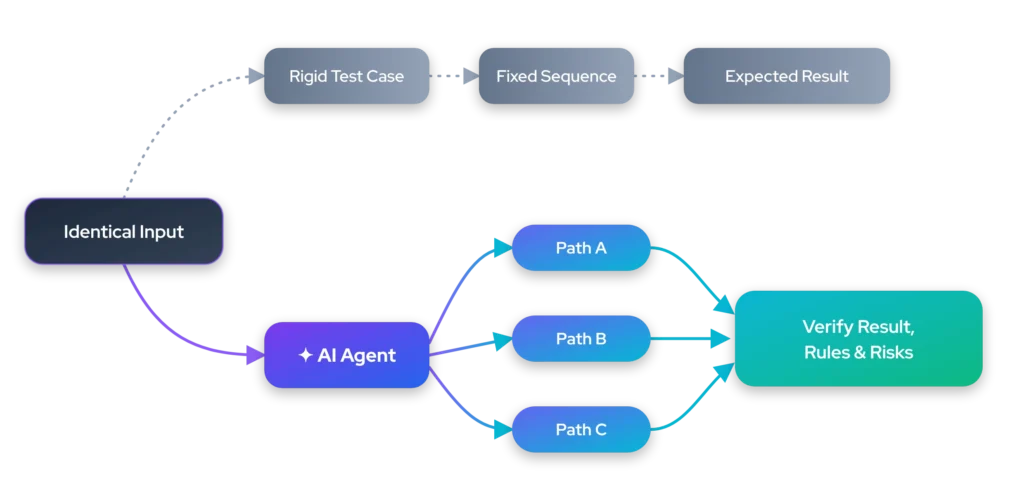
An AI agent reviews incoming complaints, gathers information and proposes a resolution.
A classic test would only check whether a credit note was issued. A behavior test checks whether the path to it stayed within the allowed boundaries.
Whether human or machine, anyone testing AI agents has to do three things:
This is where Drvless comes in – Objentis’ visual AI automation agent. Drvless recognizes on-screen content with AI, operates applications via mouse and keyboard just like a person, and prepares the results for test management.
The Ideation module generates test cases from existing information and, once approved, hands them straight to automated test execution.
Because Drvless can run in production, testing and 24/7 application monitoring come together: what was verified before go-live is continuously watched in operation.
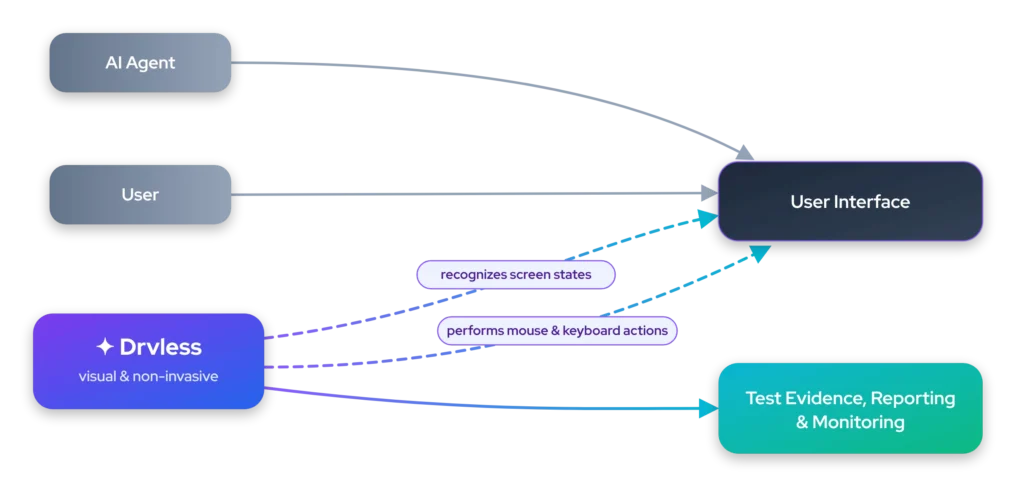
When agents or target systems offer limited transparency, a visual approach gives you an independent end-to-end view of what’s really happening:
One caveat: visual tests don’t replace other test layers. They don’t check internal data flows, API calls or security mechanisms. They deliver the most value as an additional layer alongside API, security and data testing. For a comparison of the two approaches, see Drvless vs. Code-Based Testing.
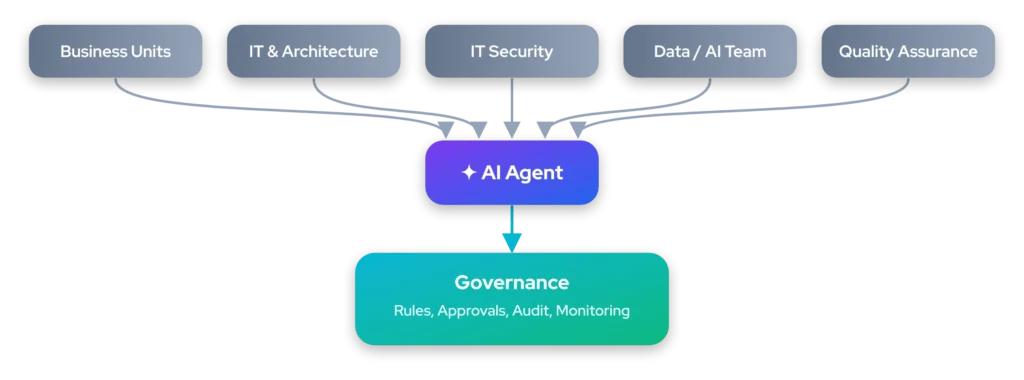
The business unit, IT and architecture, IT security, data and AI teams, or quality assurance? All of them contribute – what matters is clearly defined roles and responsibilities.
Deloitte’s The State of AI in the Enterprise 2026 shows there’s work to do: adoption of agentic AI is growing faster than the controls around it. Only about one in five companies has a mature governance model for autonomous AI agents.
Visual test automation makes sure an AI agent works correctly before it goes live. Monitoring makes sure it stays that way in operation. Objentis combines both – with tools for visual test automation, process automation and 24/7 monitoring, plus consulting on testing AI systems.
Classic tests remain indispensable. But for AI agents, outcome- and sequence-based test cases alone fall short, because paths and results vary. What counts is whether an agent makes its decisions strictly within defined boundaries.
A visual, behavior-based testing approach complements existing quality assurance: it observes agents in their real working environment and evaluates outcomes and rules instead of rigid step sequences. Drvless does this by combining AI-based visual recognition with mouse and keyboard interaction – no plugins, no SDKs.
You are currently viewing a placeholder content from Vimeo. To access the actual content, click the button below. Please note that doing so will share data with third-party providers.
More InformationYou are currently viewing a placeholder content from YouTube. To access the actual content, click the button below. Please note that doing so will share data with third-party providers.
More InformationYou need to load content from reCAPTCHA to submit the form. Please note that doing so will share data with third-party providers.
More Information