
Modern CI/CD pipelines provide fast and reliable feedback. Unit tests, API tests, integration tests, and static analysis all help teams identify issues early.
Yet some problems only become visible when an entire business process is executed from start to finish.
This is not an argument against shift-left testing. On the contrary, early testing remains essential. It validates components, interfaces, and logic where defects are usually quickest and least expensive to resolve. But it cannot fully answer whether a customer journey or business process actually works across multiple systems, devices, and areas of responsibility.
The most difficult issues often arise at those handover points: data arrives late, one system waits for an event that never occurs, a status is not transferred correctly, or a process works technically but fails from the user’s perspective.
Shift left where it makes sense. Orchestrate where it becomes necessary.
In practice, business processes rarely remain within one application.
Take a typical customer journey: a customer places an order in an online shop, perhaps confirms their identity through a mobile app, pays through an external provider, and receives a confirmation email. In the background, inventory may be updated, data passed to internal systems, and documents archived.
Each system may work correctly on its own. Still, the complete journey can fail because of a missing handover, a timing issue, or an unexpected system state.
The challenge is therefore often not within the individual applications, but in the connections between them.
End-to-end automation is not simply about executing several individual tests in sequence.
Orchestration connects different automations into one controlled process. It coordinates test steps across systems and devices, transfers data between them, triggers events at the right time, and produces one consolidated result.
This makes it possible to test a process that includes a customer portal, internal services, a legacy system, cloud storage, and an external notification provider as one connected and traceable workflow.
Instead of testing individual parts separately and checking handovers manually, teams can automate and assess the complete process.
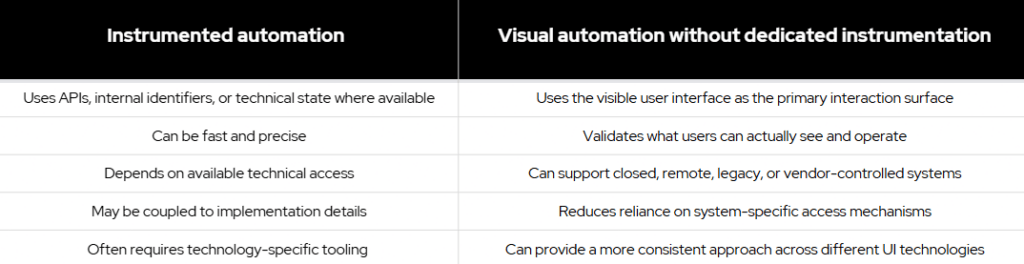
Traditional automation often relies on technical access mechanisms such as DOM elements, APIs, accessibility trees, stable IDs, or dedicated test hooks.
Where those mechanisms are available and stable, they should of course be used. They enable precise interactions and often provide detailed technical information.
In many real-world system landscapes, however, that access is unavailable, impractical, or not permitted. This may apply to:
There is another consideration: tests that depend heavily on internal technical details can become costly to maintain when the implementation changes.
And even if a system reports the correct internal state, that does not necessarily mean that its interface is usable for real users.
When no dedicated instrumentation is available, automation can use the same interface as a human user: the screen, keyboard, mouse, and touch.
Automation can observe what appears on screen, interact with visible elements, and verify whether the expected feedback is displayed. This has an important advantage: it does not only verify whether a system has processed something internally. It verifies whether the result is actually visible, understandable, and usable from the user’s perspective.
That does not mean visual automation should replace APIs or stable technical identifiers. Rather, it complements them—especially where conventional access mechanisms are unavailable.
AI can make visual automation more robust. It can help recognize buttons, input fields, text, error messages, status indicators, and other visible elements across different technologies.
Its role, however, should remain clearly defined.
AI helps answer the question:
“What is currently visible on the screen?”
Test logic answers a different question:
“What should happen next?”
Test steps, data flows, expected results, and pass/fail criteria should remain deliberately and deterministically defined. This keeps tests repeatable, traceable, and auditable.
AI therefore becomes a perception layer—not an uncontrolled agent that invents its own test paths.
Shift-left testing remains a central part of modern quality assurance. But for real end-to-end confidence, testing individual components or interfaces in isolation is not enough.
Whenever business processes connect multiple systems, technologies, devices, or external partners, orchestration is needed to bring those parts together into one controlled process.
Where instrumentation is available, it should be used appropriately. Where it is not, the visible user interface can become a practical and user-centred automation surface.
The goal is not to replace existing testing methods. It is to complement them, so that the business processes that matter most to organisations and their customers can also be tested automatically.
You are currently viewing a placeholder content from Vimeo. To access the actual content, click the button below. Please note that doing so will share data with third-party providers.
More InformationYou are currently viewing a placeholder content from YouTube. To access the actual content, click the button below. Please note that doing so will share data with third-party providers.
More InformationYou need to load content from reCAPTCHA to submit the form. Please note that doing so will share data with third-party providers.
More Information